Huber representatives

Visit us


Share


HUBER Solutions for Organic Waste Processing
For dry aerobic treatment (composting) as well as for wet anaerobic treatment (fermentation with biogas generation) good mechanical pre-treatment of the supplied bio-waste is essential for the reliability and performance of the entire treatment plant. Most important is not only the choice of effective and efficient processes, but also their implementation with most robust and dependable machines; both are also important for the quality of the generated products.
We have developed solutions and products for processing organic waste and for further treatment of residues for their disposal or reuse:
- Coarse material separation: Separation and treatment by screening, washing, dewatering and compaction
- Mineral treatment: Removal and processing by washing and dewatering
- Fermentation residue treatment: Post-treatment for reuse by dewatering, compaction and eventually drying
- Process/wastewater treatment: Wastewater treatment and process water recycling
Systems concept
Systems concept

Process
Process
Organic waste is supplied in solid or liquid form, the latter being mainly contents of grease trap. For their reception bunkers we supply customized stainless steel covers.
The supplied waste is first ground in a mill and conveyed to a pulper whereby metals are separated. In the pulper they are soaked in hot process water, mixed, homogenized and disinfected.
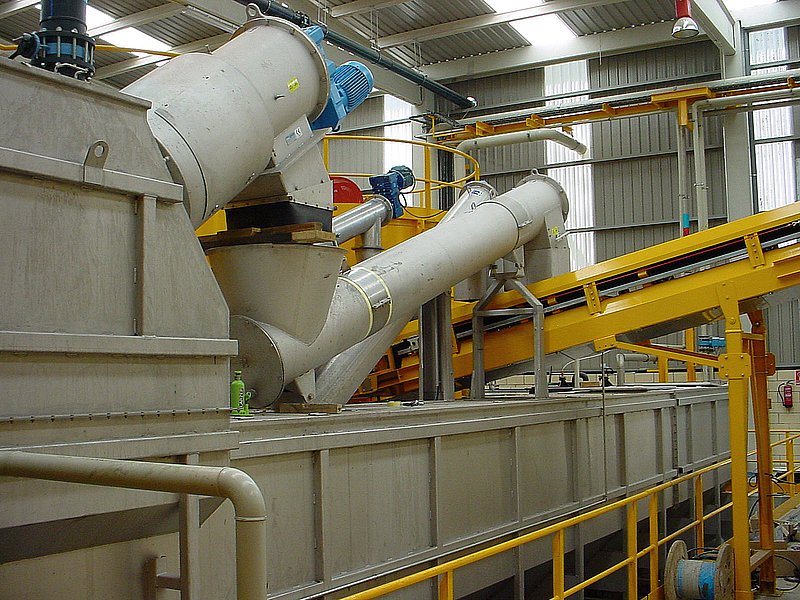
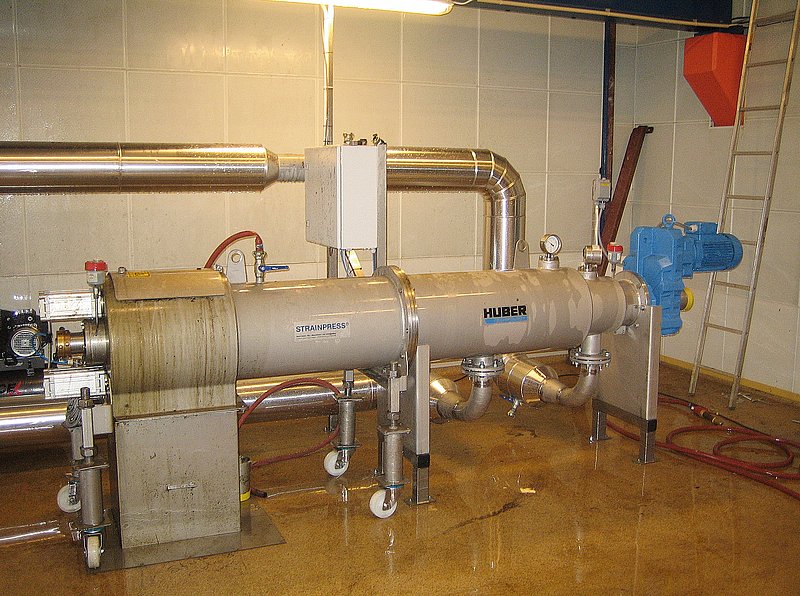
The thus generated hot slurry is then mechanically pre-treated in a HUBER Complete Plant ROTAMAT® Ro5 (special Bio version) that is specifically adapted for this task. Debris and other disturbing solids (e.g. packing and wrapping materials) are removed with an integrated Fine Screen, and heavy mineral solids (e.g. stones, grit, sand and broken glass) are separated in an aerated Grit Chamber. The removed screenings are washed and compacted in our HUBER Wash Press WAP®, the separated mineral solids are washed and dewatered in our HUBER Coanda Grit Washer RoSF4. The compacted screenings are incinerated as solid waste and the washed grit is reused as construction material. In order to remove even finer solids (e.g. hair and fibres), that could form disturbing scum layers in the fermenter, we provide a HUBER Sludgecleaner STRAINPRESS®.
Within the fermenter the organic substrate is anaerobically degraded whereby biogas is produced. The biogas is used to generate power and heat in a cogeneration plant. The non-degradable fermentation residues are dewatered with our HUBER Screw Press S-PRESS, and their amount can be further reduced in a HUBER Belt Dryer BT. We use the heat generated by cogeneration for the drying process. Dewatered or dried fermentation residues are either utilized energetically as fuel, or materially as fertilizer and for soil improvement.
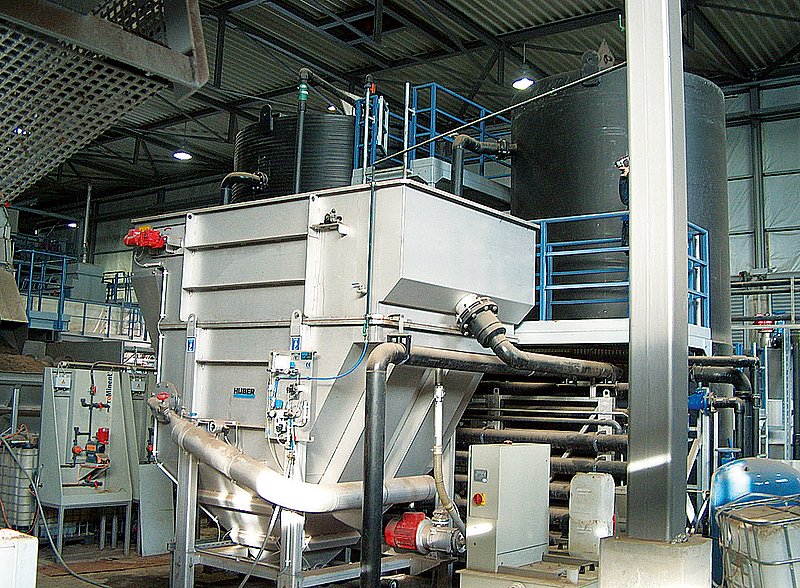
Wastewater that has been generated in the various treatment processes is collected, chemically conditioned and treated in a HUBER Dissolved Air Flotation Plant HDF. The removed flotate sludge is returned into the pulper. The treated effluent is recycled as process water, it is either heated with heat exchangers and fed into the pulper, or used as wash water.
When we implement our solutions, we also provide our well-proven HUBER stainless steel components, e.g. Screw Conveyors or Manhole Covers.
Case Studies
Case Studies
Downloads
Downloads
- Brochure: HUBER Solutions for Biowaste Treatment[pdf, 485 KB]
Photos
Photos